Turning Customer Frustration into Cultural Gold via Storytelling
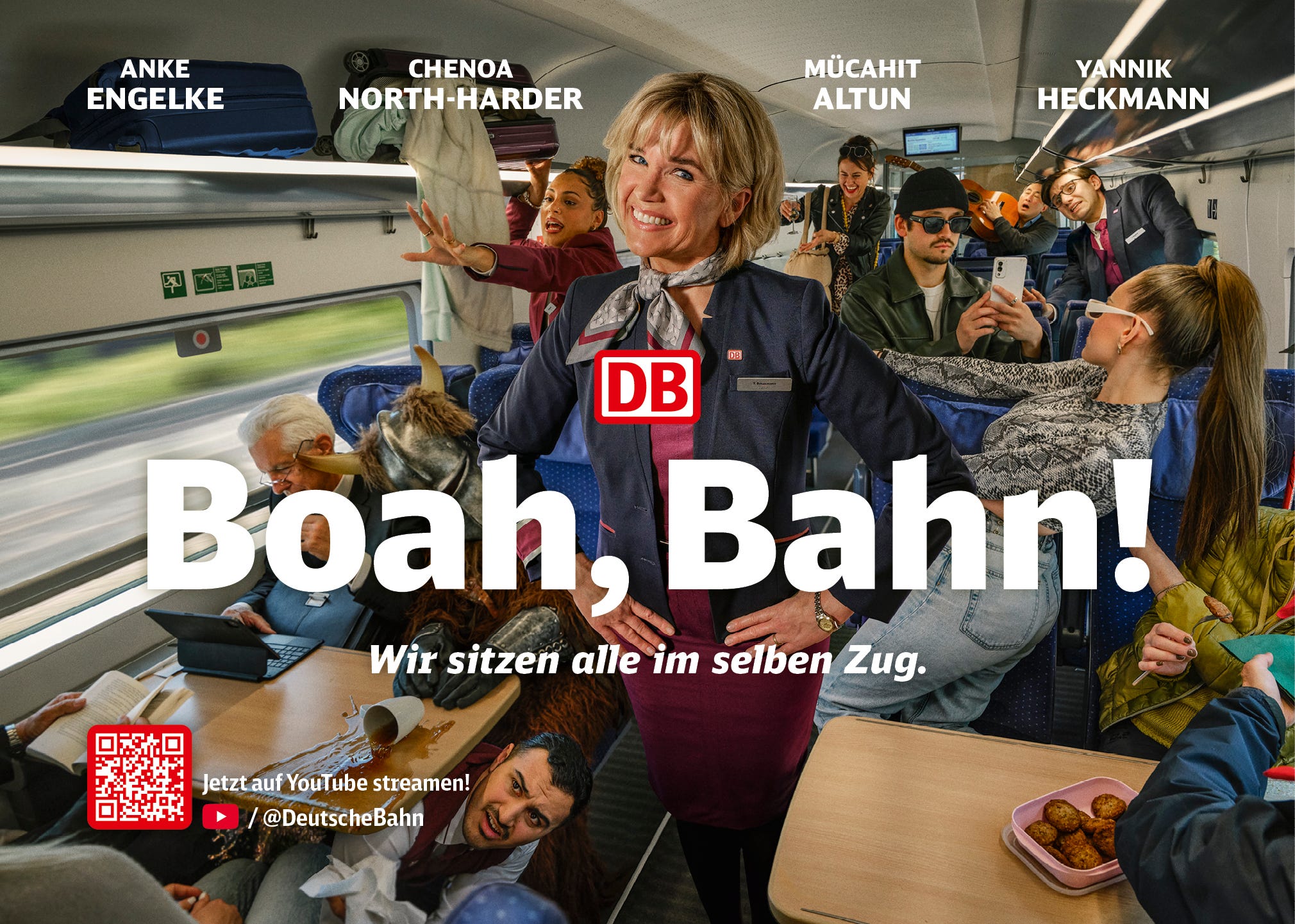
Following the oversaturation of our social media feeds with orange hued Canva templates accompanied by either burning hearts or orange ones, the conversation asking: to trendjack or not to trendjack has restarted once again.
A counter macro-trend on social is brands leaning into more episodical content series. The first time I noticed this shift was in August last year, when the branded TikTok Show ‘The Dealership’ by Mohawk Chevrolet was on everyone’s* lips (*every marketer’s), so much so it made it to a number of news outlets. In more recent months other brands followed suit – Bilt with ‘Roomies’, InStyle with ‘The Intern’, Argos with ‘Arghaüs’ and many others. However, this seems to be one of those trends that have come back around after 10 years, because in 2014 Chipotle launched a satirical web series (4 episodes) called ‘Farmed and Dangerous’ as branded storytelling. It’s often cited as an early branded “show”.
So why is it deemed so effective now? Well, just as it would have been before consistency builds not only trust, it feeds the algorithm, and with the right story telling your core brand message may just stick.
And why have I decided to write about this? Because I think the Deutsche Bahn (German National Rail Company), just created a best practice example of this, and this is my attempt to build a case study for it.
Some context
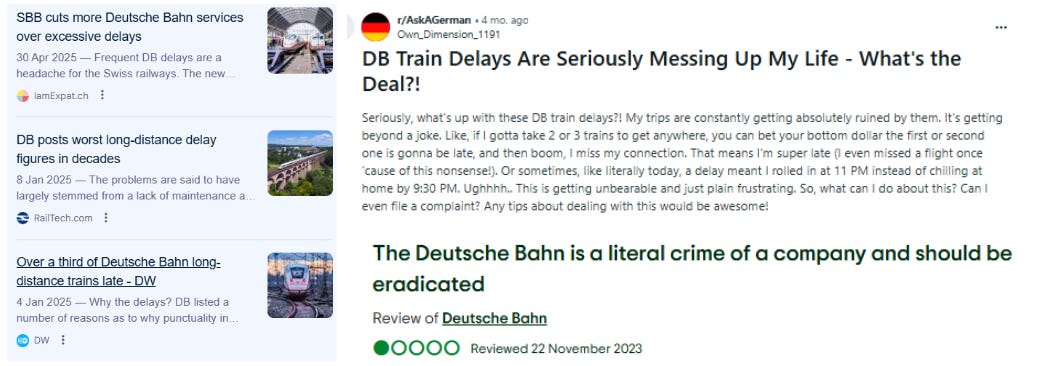
Image: A selection of screenshots outlining the general consensus about DB’s punctuality
For context, DB (short for Deutsche Bahn) has, for as long as I can remember, had the reputation of being late. And the data backs it up: punctuality for long-distance journeys has sharply declined since 2020, reinforcing public frustration and making the brand an easy target for memes and sarcasm.
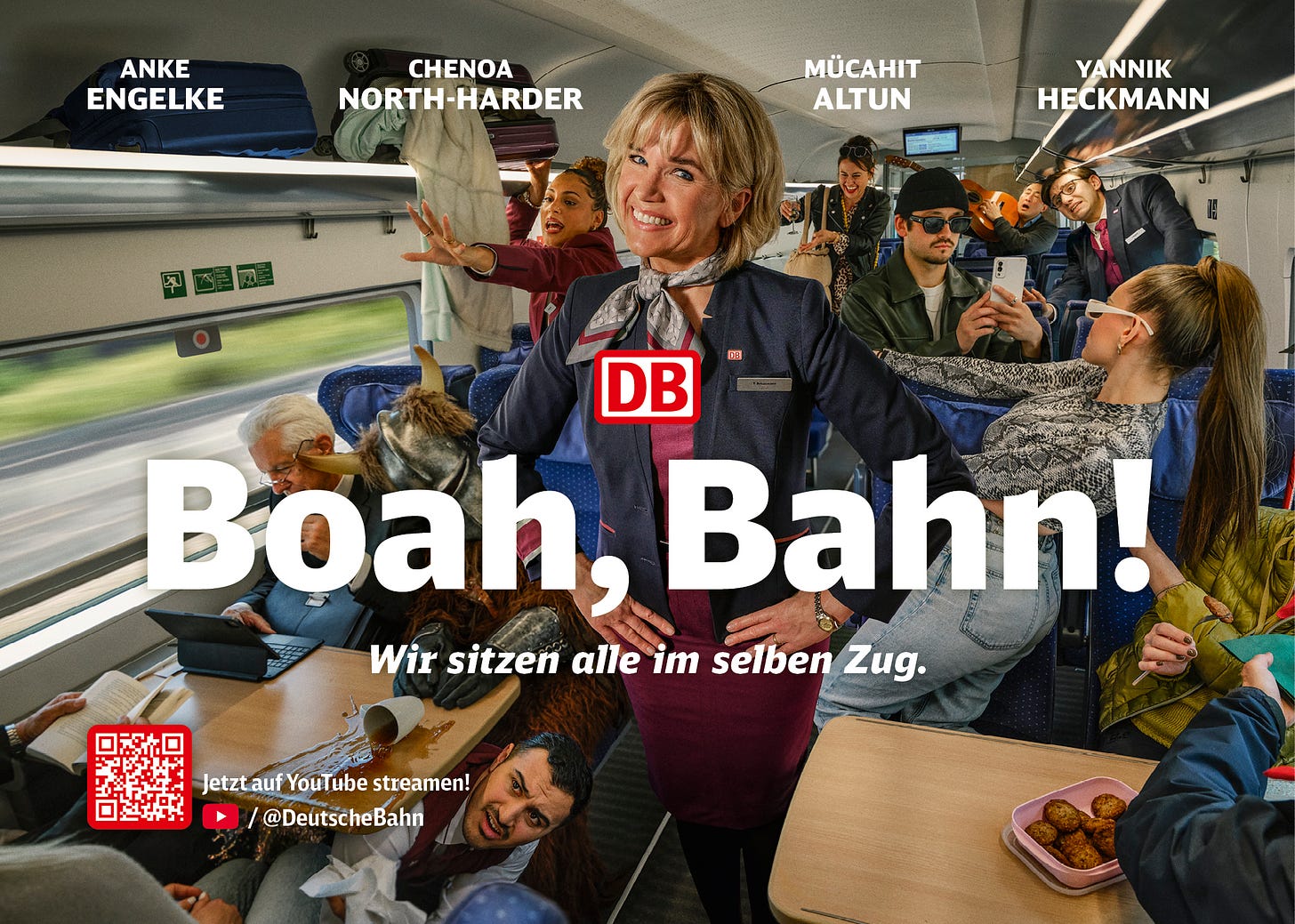
Enter ‘Boah, Bahn! Wir sitzen alle im selben Zug.’ – literally “We’re all on the same train” – a play on the phrase “We’re all in the same boat.” It’s Deutsche Bahn’s first-ever fictional web series, featuring actor and comedienne Anke Engelke as ICE train manager Tina. Through humour and storytelling, DB reframes its most criticised traits as shared, human experiences – reminding viewers that staff and passengers are navigating the same chaos together.
The challenge
Deutsche Bahn set out to shift how people talk about the brand. The goal wasn’t to deny delays or distract from them, but to show self-awareness, humanise the brand, and re-engage audiences through humour. The creative challenge was simple but bold: how do you take a long-running national frustration about DB’s lateness (that people pay a lot of money for!) and use it to build brand affinity, relatability, and engagement?
The creative solution
At its core, Boah, Bahn! reframes Deutsche Bahn’s reputation problem through storytelling rather than apology. Instead of releasing a corporate statement or service update, DB built a fictional world around its reality – using humour to reclaim control of the narrative. This move also buys them time, as they are yet to resolve the issues impacting the trains’ punctuality, there won’t be an overnight solution.
It’s stellar casting with Anke Engelke, a household name in Germany, known for her dry wit and ability to make self-deprecating humour feel sincere. By putting her in the role of a train manager who deals with everyday chaos but mostly showcases how everyone is affected by DB’s train delays inclusive of the railway staff, DB signals humility and cultural awareness. Strategically, it moves DB from being the target of jokes to being in on it.
“With love for the job, humor and team spirit, Tina and her crew accompany their passengers on their journey across Germany, face all challenges and always stick together despite all adversity,” is how Deutsche Bahn describes its campaign.
Execution
The campaign was built for both storytelling and shareability. Six short episodes (three to four minutes each) premiered on YouTube in October 2024, directed by Arne Feldhusen (Stromberg, Der Tatortreiniger) and produced by wtf GmbH – a joint venture between btf / bildundtonfabrik and Elastique.
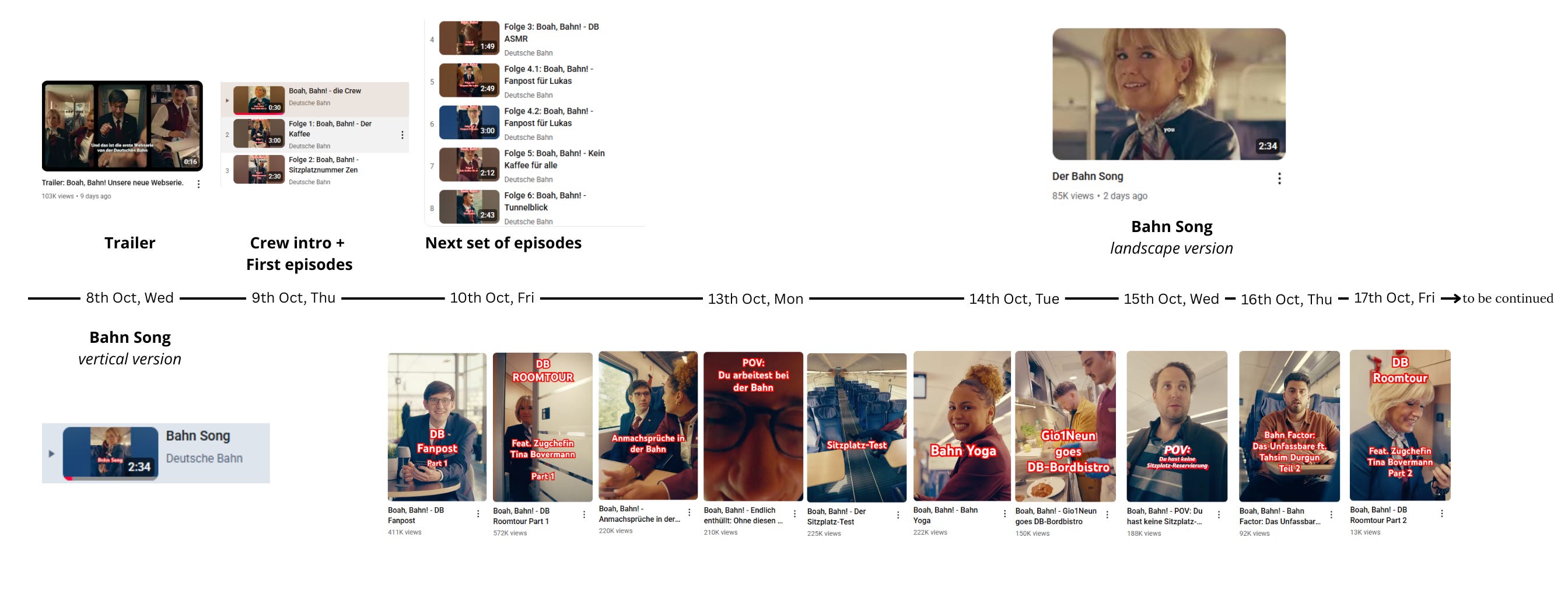
Each episode was then adapted into shorter edits for TikTok and Instagram, ensuring the tone – observational, self-aware, and slightly absurd – stayed consistent across channels. DB also used paid media to drive reach, but the strongest traction came from organic engagement: clips were shared, quoted, and remixed, especially by younger audiences who rarely engage with DB’s official comms.
What’s particularly smart is how the campaign extended beyond the videos. DB’s social team mirrored the series’ tone in community management, replying to comments and building a conversational loop between fiction and reality – ‘Before you ask: yes, all episodes will be released on time!’.
And then, they ALSO activated with creators:
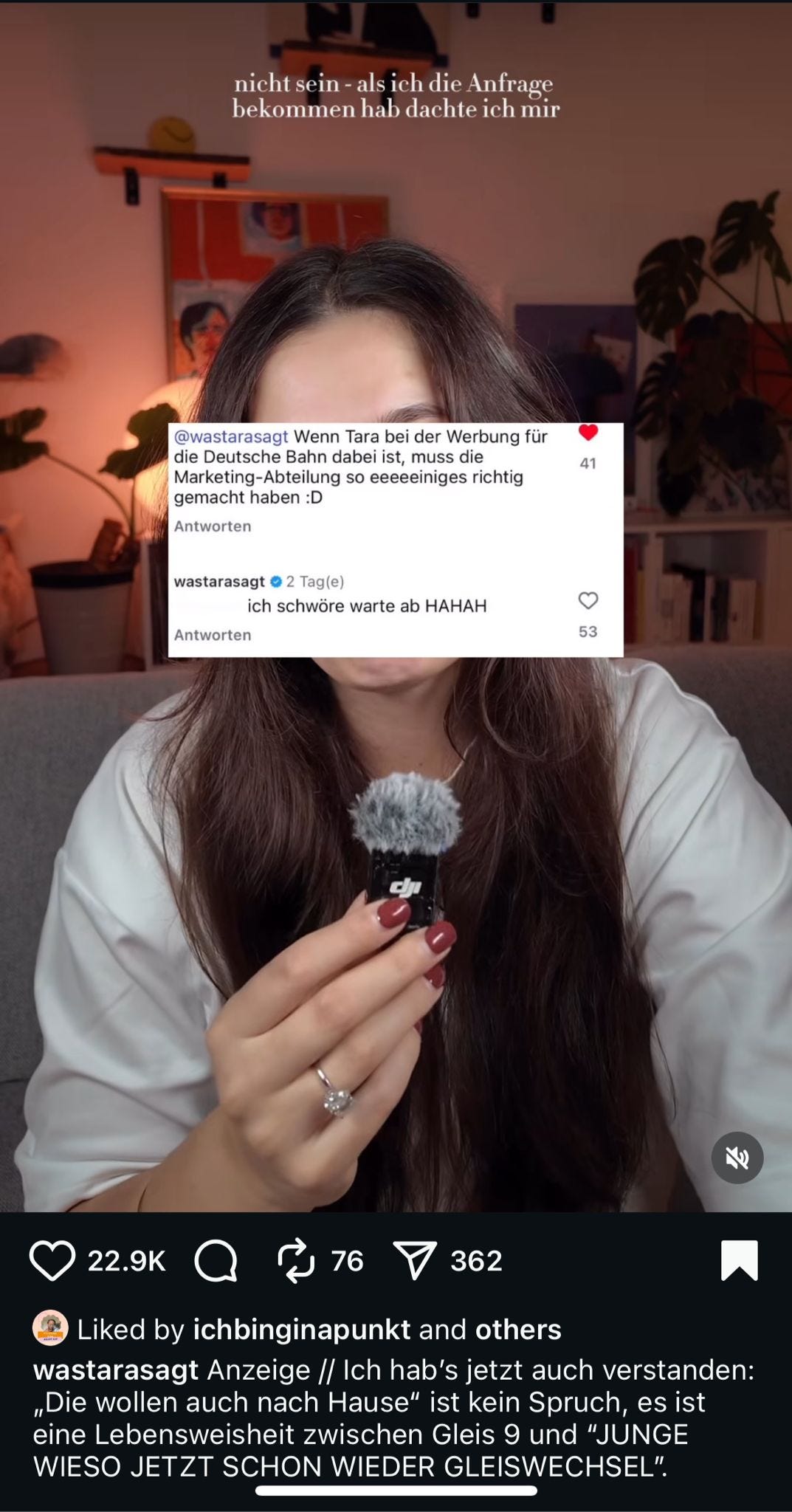
Source: Screenshot from instagram.com/wastarasagt
Impact
Across 55 posts shared on TikTok, YouTube, Instagram, and Facebook, the campaign generated a total of 64.9M views, averaging 1.18M views per post.
- Instagram led performance with 28.4M views across 15 posts (avg. 1.9M per post) – driving the strongest engagement and shareability.
- TikTok followed with 19.3M views (avg. 1.6M per post) and strong early traction despite a limited number of posts.
- YouTube delivered 13M views (avg. 619K per post), reinforcing the campaign’s long-form strength.
- Facebook added 3.2M views (avg. 457K per post), sustaining reach among legacy audiences.
Whilst a brand lift study is still required to confirm impact, early indicators suggest overwhelmingly positive sentiment and significant awareness across multiple channels. Audience reactions were highly engaged, with comments like ‘At least something to laugh about for once, instead of getting frustrated.’ reflecting cultural resonance and tone alignment. But notably there were also many negative comments still airing frustrations.
The campaign also received substantial earned media attention, including coverage on TV where Anke Engelke discussed it, alongside strong press pickup. The data reflects only early performance, as additional content continues to roll out – signalling potential for even greater reach and sustained momentum.
Why I think this approach works
Deutsche Bahn’s biggest problem isn’t awareness – it’s trust erosion over time. The brand’s lateness isn’t a short-term crisis that a campaign can “solve.” It’s a systemic issue tied to infrastructure, underinvestment, and political complexity. No amount of performance marketing or punctuality stats can shift how people feel about DB in the short term.
That’s where Boah, Bahn! becomes strategically sharp. It doesn’t try to promise improvement; it builds empathy instead. By reframing the brand through humour and storytelling, DB changes the emotional context of the conversation without needing to fix the structural problem overnight.
Storytelling becomes a stopgap form of brand repair:
It buys cultural goodwill – audiences are more forgiving of flaws when the brand shows it understands them.
It humanises the organisation – moving focus from “the system fails” to “the people inside it care.”
It shifts expectations – the brand isn’t pretending perfection, it’s acknowledging reality.